Have you ever come across the word raiment in the Bible and wondered about its deeper meaning? This ancient English term refers to clothing or garments, but its biblical significance goes beyond physical appearance.
The Raiment Meaning in the Bible reveals powerful lessons about identity, spiritual covering, purity, and God’s grace. From Adam and Eve’s first garments to Jesus’ shining clothes during the Transfiguration, raiment represents important moments in Scripture.
In this guide, we will explore its Hebrew and Greek origins, biblical references, spiritual symbolism, and practical lessons for Christians today.
Raiment Meaning in the Bible
Raiment means clothing. It is an older English word the KJV uses for garments in general, and it works as a collective term, like “clothing” today.
It does not name a sacred garment, and it does not mean fancy dress. The same word covers a poor man’s only cloak and a king’s wardrobe.
Newer translations usually say “clothes” or “clothing,” which is why raiment feels so King James.
Raiment Meaning in Hebrew and Greek Biblical Languages
No single original word sits behind raiment. The KJV translators used it for several.
Hebrew words
- Beged (H899): a covering or garment. It is the most common source, as in Genesis 24:53 and Genesis 28:20.
- Kesuth (H3682): a covering. It appears in Exodus 21:10 in the marriage law.
- Simlah (H8071): a mantle or wrapper. It appears in Deuteronomy 8:4 and 10:18.
Greek words
- Himatismos (G2441): clothing, used in Luke 9:29.
- Enduma (G1742): apparel, used in Matthew 3:4, 6:25 and 6:28.
- Esthes (G2066): dress, used in James 2:2.
- Skepasma (G4629): a covering, used in 1 Timothy 6:8.
- Himation (G2440): the common word for an outer garment, which the KJV renders raiment about a dozen times.
Key Bible Verses
- Genesis 28:20: Jacob asks God for “bread to eat, and raiment to put on.”
- Deuteronomy 8:4: “Thy raiment waxed not old upon thee, neither did thy foot swell, these forty years.”
- Matthew 6:25: “Is not the life more than meat, and the body than raiment?”
- Matthew 17:2: at the Transfiguration, “his raiment was white as the light.”
- 1 Timothy 6:8: “And having food and raiment let us be therewith content.”
- Revelation 3:18: Christ counsels the church to buy “white raiment, that thou mayest be clothed.”
Biblical Context
In the ancient world, clothing was handmade, costly, and hard to replace. That is why the law protected it.
A neighbor’s cloak taken as a pledge had to be returned by sundown, because it was “his raiment for his skin” (Exodus 22:26-27). A widow’s raiment could not be taken in pledge at all (Deuteronomy 24:17).
Clothing also marked occasions and favor. Rebekah received raiment as a gift (Genesis 24:53), and Jacob wore Esau’s “goodly raiment” to win a blessing (Genesis 27:15). Joseph changed his raiment before standing in front of Pharaoh (Genesis 41:14).
Read Also: Meaning of Damian in the Bible: Divine Truths & Significance!
Difference Between Raiment, Garments, and Robes in the Bible
These words overlap, but they are not identical.
| Term | Basic sense | Example |
| Raiment | Clothing in general (collective) | Genesis 28:20 |
| Garment | One article of clothing | Matthew 9:20 |
| Robe | Long outer garment, often a sign of rank or office | Luke 15:22 |
| Vesture | Poetic word for clothing | Genesis 41:42 |
| Apparel | Dress, often noting quality or occasion | Acts 12:21 |
One caution matters here. Not every clothing verse is a “raiment” verse. The coats God made for Adam and Eve (Genesis 3:21) and Joseph’s coat (Genesis 37:3) use a different Hebrew word, kethoneth.
The robe given to the prodigal son (Luke 15:22) uses the Greek stole. They belong to the wider clothing theme, but a search for “raiment” will not find them.
Spiritual Meaning in the Bible
Where raiment appears in the KJV, it is usually literal first. Spiritual lessons grow out of that.
- Provision. Raiment is paired with food as the basic need of life. Deuteronomy 10:18 shows God giving “food and raiment” to the stranger.
- Contentment. Paul sets raiment beside food as the measure of “enough” (1 Timothy 6:8).
- Glory. The whiteness at the Transfiguration shows heavenly glory, not human effort (Matthew 17:2; Luke 9:29).
- Gift. Revelation 3:18 presents white raiment as something Christ supplies.
- Cleansing. In Zechariah 3:4, filthy clothing is removed and Joshua is clothed with “change of raiment,” a picture of forgiveness.
Read Also: 888 Biblical Meaning: What Does This Number Mean Spiritually?
Biblical Symbolism
Clothing carries meaning throughout Scripture, and raiment shares in it.
Positive pictures
- White raiment: victory and glory (Revelation 3:5)
- Fresh clothing: pardon and restoration (Zechariah 3:4)
- Royal clothing: honor and authority
Warning pictures
- Torn clothes: grief or distress (Genesis 37:29)
- Stained raiment: judgment (Isaiah 63:3)
- Fine raiment valued above the person: partiality (James 2:2-4)
What Does Raiment Represent in Dreams and Spiritual Life?
The Bible gives no dream dictionary for raiment, so any claim that a specific dream “means” something should be held loosely. What Scripture does supply is a set of themes: covering, provision, shame removed, and glory given.
If clothing appears in a dream, those themes can be a starting point for prayer and reflection. Test any conclusion against Scripture, and treat a dream as a prompt for reflection, not as authority.
Common Misunderstandings
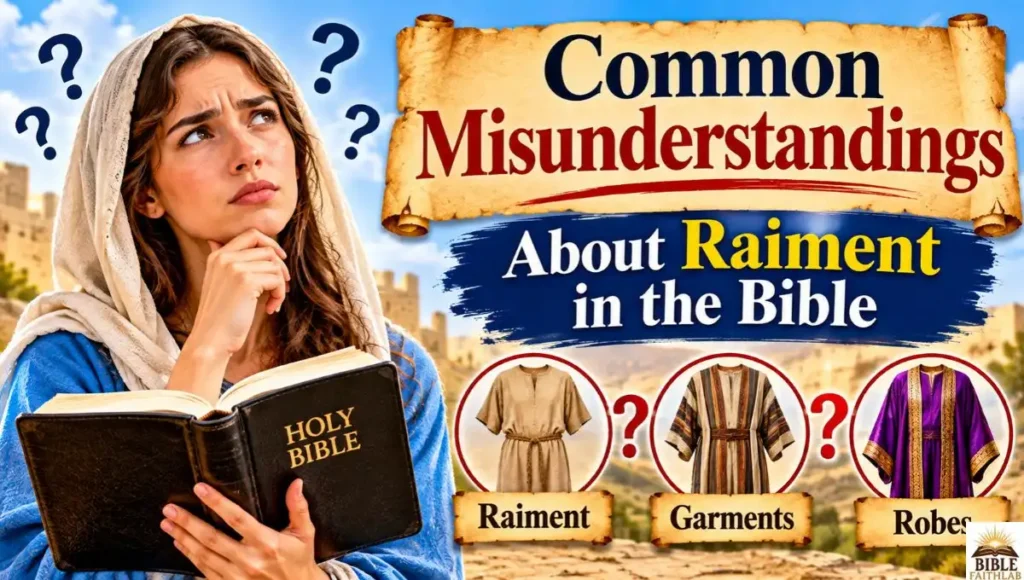
- “Raiment means fancy clothing.” It simply means clothing, rich or poor.
- “Every raiment verse is symbolic.” Many are plain statements about daily need.
- “White raiment is earned purity.” The texts present it as glory or as a gift from Christ.
- “Raiment appears in Genesis 3.” That verse uses kethoneth (coats), not the word translated raiment.
Read Also: What Does Grayson Mean? Biblical Meaning Revealed!
Daily Christian Application
- Trust over anxiety. Read Matthew 6:25-31 when worry about provision builds. The passage targets anxiety, and it still assumes God clothes his creation.
- Practice contentment. Ask what “enough” looks like for you, using 1 Timothy 6:8 as a measure.
- Honor people equally. Take James 2 as a check on how you treat people by appearance.
- Receive, don’t earn. When guilt lingers, remember Zechariah 3 and Revelation 3:18, where covering is given.
Frequently Asked Questions
What is the definition of raiment in the Bible (KJV)?
Raiment means clothing or garments in general. The KJV uses it for several Hebrew and Greek words.
What is the meaning of raiment in Hebrew?
The main Hebrew word is beged, meaning a garment or covering. Kesuth and simlah are also rendered raiment.
How do you pronounce raiment?
It is pronounced “RAY-ment,” with the stress on the first syllable.
What does vesture mean in the Bible?
Vesture is a poetic word for clothing, as in “vestures of fine linen” (Genesis 41:42). It also appears in Psalm 22:18 and Revelation 19:13.
What does arrayed mean in the Bible?
Arrayed means dressed or clothed, often splendidly. Matthew 6:29 says Solomon “was not arrayed like one of these” lilies.
What does mote mean in the Bible?
A mote is a tiny speck. Jesus uses it in Matthew 7:3 to contrast a small fault in someone else’s eye with the “beam” in your own.
Conclusion
Raiment meaning in the Bible starts with something simple: clothing, and especially the clothing a person cannot do without.
From Jacob’s prayer to Paul’s call to contentment, it points to God’s practical care. The richer symbolism around white and clean clothing grows from that foundation.
The most useful way to read the word is to keep each original term distinct and let each passage speak for itself. Raiment reminds us that God provides what we need, and that the covering we need most is a gift to receive.

M Uzair is a Christian content writer at Bible Faith Lab with 4 years of experience researching Bible meanings, prayers, and Christian teachings. He aims to make biblical concepts easy to understand and inspire readers to grow in faith through Scripture-based content.