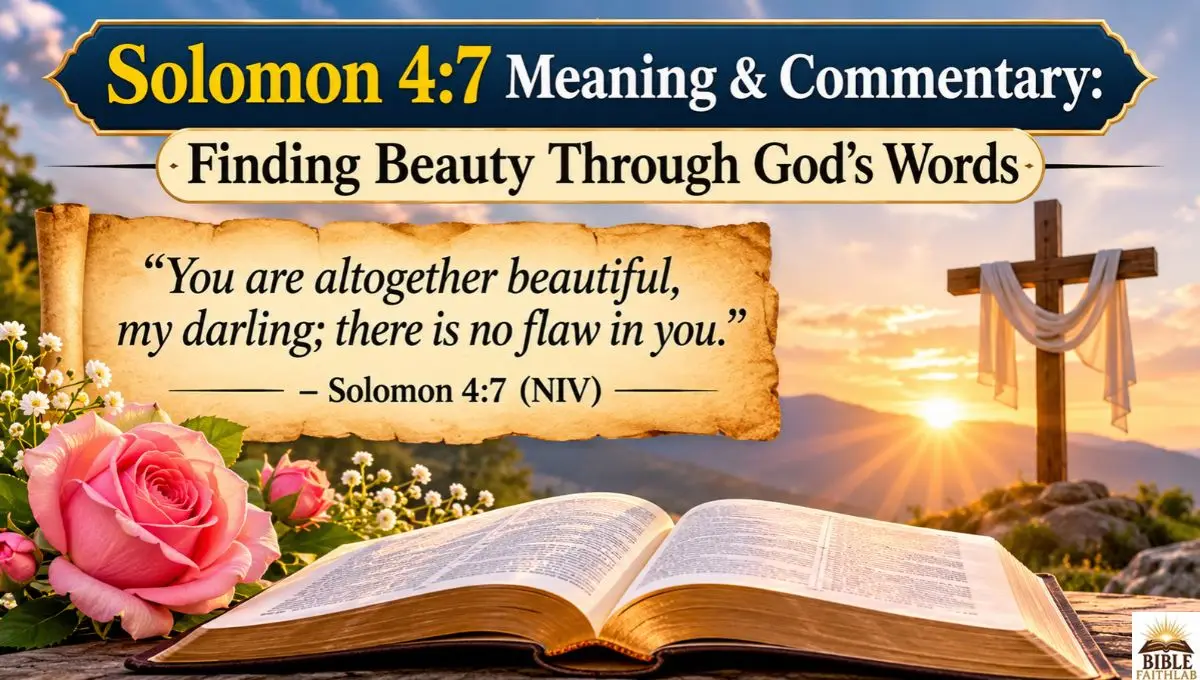
Have you ever heard someone say “you’re perfect” and quietly wondered if they truly knew your flaws? Most of us have. We replay mistakes and struggle with self-doubt. Yet Solomon 4:7 Meaning offers a beautiful reminder of love, acceptance, and spiritual worth.
The verse declares, “You are altogether beautiful, my darling; there is no flaw in you” (NIV). This guide explores the verse’s poetic context, Hebrew imagery, and connection to God’s grace.
Discover how its message of beauty, unconditional love, and spiritual identity in Christ can transform your perspective and strengthen your faith through meaningful daily devotionals.
What Is the Meaning of Solomon 4:7 in the Song of Solomon?
A groom ends his praise of his bride by declaring her completely beautiful and without blemish. In context, it celebrates covenant love.
Christians also read it as a picture of Christ’s love for the church, a layer that grows from the literal meaning rather than replacing it.
Solomon 4:7 Meaning in Different Bible Translations
The wording changes, but the meaning holds steady.
| Version | Song of Solomon 4:7 |
| KJV | Thou art all fair, my love; there is no spot in thee. |
| NKJV | You are all fair, my love, and there is no spot in you. |
| NIV | You are altogether beautiful, my darling; there is no flaw in you. |
| ESV | You are altogether beautiful, my love; there is no flaw in you. |
| NLT | You are altogether beautiful, my darling, beautiful in every way. |
| The Message | You’re beautiful from head to toe, my dear love, beautiful beyond compare, absolutely flawless. |
“Spot,” “flaw,” and “blemish” all render one Hebrew idea. The NLT and The Message paraphrase more freely.
How Does Solomon 4:7 Describe Beauty and Flawlessness?
The Hebrew behind “altogether beautiful” (kullāk yāfāh) means roughly “all of you is beautiful.”
The praise is total, not partial. It caps the head-to-toe portrait in verses 1–5, and “flawless” here reads as delight, not inspection.
The text itself praises her appearance; inner beauty is developed elsewhere in Scripture.
Who Is the “Darling” in Solomon 4:7?
The “darling” is the bride. The Hebrew term carries the sense of a companion or close friend. In verses 8–12 he also calls her “my bride” and “my sister,” an affectionate phrase in ancient love poetry.
Christians see in her the redeemed people of God, treasured as a companion rather than tolerated as a servant.
What Is the Spiritual Significance of “No Flaw in You”?
The Hebrew word for flaw, mum, means a blemish. Leviticus 22:20 uses it for defects that disqualified an animal from sacrifice. So “no flaw” suggests being fit and acceptable.
The New Testament echoes this when Christ presents the church “without stain or wrinkle” (Ephesians 5:27).
What Is the Historical and Cultural Context of Song of Solomon 4:7?
The Song of Songs sits among the Old Testament’s poetic books and celebrates married love as God’s gift. Its images come from hill-country life: goats on Gilead’s slopes, a tower of stone, pomegranates.
They sound odd today, but they praised strength, health, and charm. Tradition links the Song to Solomon, though scholars debate how to read “of Solomon” in 1:1.
How Did Ancient Israelite Marriage Customs Influence This Bible Verse?
Marriage was a family covenant, and weddings were community events. A feast could last a week (Judges 14:12), and praise of the bride belonged to that public joy.
The “garden locked up” in 4:12 is often read as a sign of exclusive faithfulness. Verse 7 therefore works as a covenant-minded declaration as well as a compliment.
Read Also: The Amazing Biblical Meaning of the Name Alyssa: Origin, Spiritual Significance, and Symbolism
What Poetic Devices Are Used in Solomon 4:7?
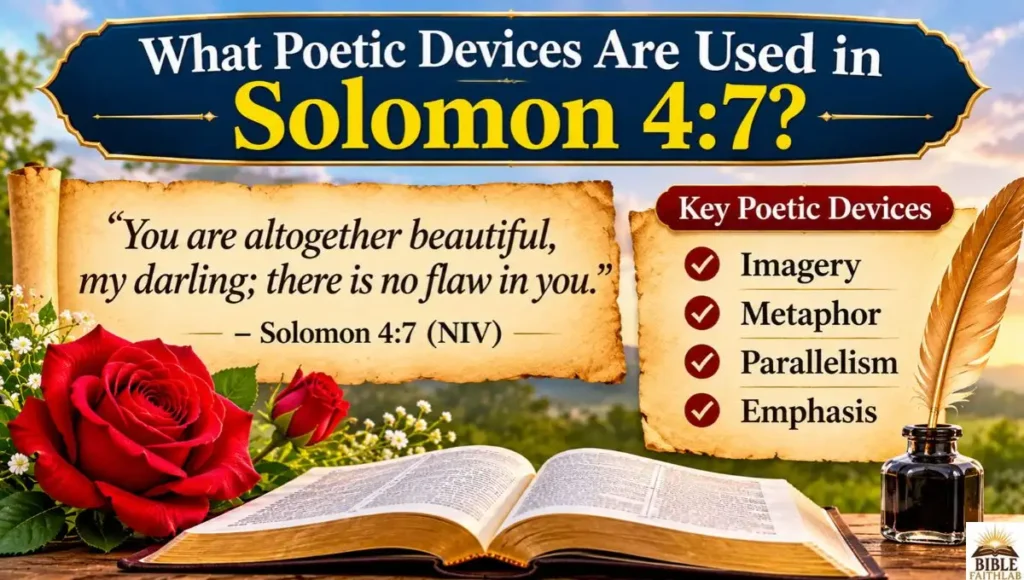
- Parallelism: “altogether beautiful” and “no flaw” state one idea positively, then negatively.
- Hyperbole: “altogether” stretches praise to its limit, as love does.
- Metaphor: verses 1–5 compare her features to doves, sheep, and a tower. Scholars call this descriptive-praise form a wasf.
- Summary line: verse 7 gathers every earlier image into one sentence.
How Does Solomon 4:7 Reflect God’s Perspective on Beauty and Redemption?
Scripture says God looks past surfaces: “the Lord looks at the heart” (1 Samuel 16:7). Applying 4:7 to believers is a Christian application, not the verse’s original setting, but other passages support it. Isaiah 61:10 describes being clothed with “garments of salvation,” a beauty God provides.
What Does “All Beautiful, My Darling” Reveal About God’s Grace and Love?
The groom says “you are,” not “you will be.” That mirrors grace, which arrives before improvement (Romans 5:8). Ezekiel 16:14 goes further: the splendor God gave His bride made her beauty “perfect.” In Scripture, beauty is received as much as achieved.
What Does Solomon 4:7 Teach About Love, Acceptance, and Identity in God?
- Love speaks first. His praise comes before any change in her.
- Acceptance is personal. He addresses her with a name of affection, “my darling.”
- Identity is relational. “My beloved is mine and I am his” (Song 2:16).
How Is Flawlessness Connected to Christ’s Redemption in the Bible?
Believers are redeemed by the blood of “a lamb without blemish or defect” (1 Peter 1:19), language that echoes mum.
Colossians 1:22 says Christ presents them “holy in his sight, without blemish and free from accusation.” Yet 2 Peter 3:14 urges effort to be found “spotless, blameless.” Flawlessness is declared now and grown into over time.
Read Also: Cynthia Name Meaning in the Bible: Spiritual Significance, Faith, and Symbolism
How Does This Verse Relate to the Church as the Bride of Christ?
Ephesians 5:25–27 says Christ loved the church and gave Himself for her. 2 Corinthians 11:2 and Revelation 19:7 continue the bridal picture, and Isaiah 62:5 says God rejoices over His people as a bridegroom over a bride.
Matthew Henry warned against fanciful guesses about each image, so keep the big picture in view.
How Can Believers Find Personal Beauty Through God’s Words in Solomon 4:7?
Replace comparison with a short practice. Write three lines: what I’m telling myself, what Scripture says, and one thing I’ll do today.
For example, trade “I’m too far gone” for “There is now no condemnation” (Romans 8:1). Repeat for a week. Change comes slowly, one honest day at a time.
How Can Song of Solomon 4:7 Encourage Healing and Confidence in Christ?
Shame loses ground when a person hears they are loved before they are fixed. Hebrews 4:16 invites believers to approach God’s throne “with confidence.”
This verse can comfort, but it does not replace a pastor or counselor if self-image struggles run deep.
How Does Understanding This Bible Verse Impact Self-Worth and Faith?
Biblical self-worth is given, not earned: “fearfully and wonderfully made” (Psalm 139:14). It differs from pride because it rests on what God has said, not on performance.
Someone who believes it can stop performing for approval, forgive faster, and serve out of gratitude instead of fear.
What Are Reflection Questions to Deepen Spiritual Growth?
- What do I assume God sees when He looks at me?
- Where do I chase approval instead of resting in acceptance?
- What part of my story am I hiding from Him?
- Who needs to hear “you are loved” from me this week?
How Can Daily Devotionals Incorporate Solomon 4:7?
Try five minutes. Read the verse aloud, pray a one-sentence thanks, then read one companion passage: Psalm 139:14, Isaiah 61:10, Colossians 1:22, Zephaniah 3:17, or Ephesians 5:27. Journal one line about what stood out, and share it with a friend.
What Related Bible Verses Reinforce the Theme of Inner Beauty and God’s Grace?
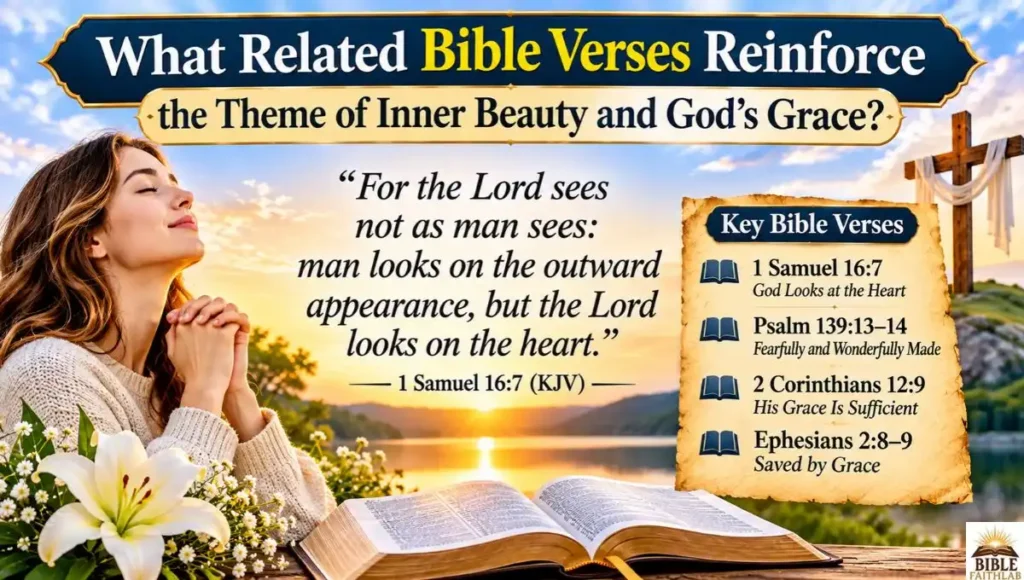
Scripture consistently locates beauty in the heart. Proverbs 31:30 calls charm deceptive and beauty fleeting, but praises the woman who fears the Lord.
1 Peter 3:4 values “the unfading beauty of a gentle and quiet spirit.” These passages keep Solomon 4:7 from being read as a beauty contest.
Read Also: Henry Name Meaning Bible: Biblical Truth, Symbolism & Facts
Which Scriptures Highlight Spiritual Beauty and Flawlessness?
- Jude 24: God is able to present you “without fault and with great joy.”
- Psalm 45:11: the king is enthralled by the beauty of his bride.
- Genesis 1:31: God called His creation “very good.”
- Song 1:15 and 6:4: the same delighted praise elsewhere in the Song.
Frequently Asked Questions
What is Song of Solomon 4:7 in English?
The NIV reads, “You are altogether beautiful, my darling; there is no flaw in you.” The KJV reads, “Thou art all fair, my love; there is no spot in thee.”
What is the meaning of Song of Solomon 4:7 in the NIV?
A groom tells his bride she is completely beautiful, with no blemish in his eyes. “Darling” is a term of affection, and “flaw” means any defect.
What does Song of Solomon 4:7 mean in the KJV?
“All fair” means completely beautiful, and “no spot” means no blemish. It is the same meaning in older English.
What is the meaning of Song of Solomon 4:7?
It is a husband’s total praise of his wife. By extension, it pictures Christ’s love for the church and the acceptance believers have in Him.
What is the meaning of Song of Solomon 4:9?
The groom says one glance of her eyes, or one jewel of her necklace, has “stolen” (NIV) or “captivated” (ESV) his heart. “Sister” is an endearment, not a family relation.
What does Song of Solomon 4:6 mean?
He says that until the day breaks and the shadows flee, he will go to the “mountain of myrrh” and “hill of incense.” Many readers take these fragrant hills as poetic images of the bride and closeness with her.
Conclusion
The Solomon 4:7 meaning works on two levels. First, it is a groom’s wholehearted praise of his bride within covenant marriage. Second, it points to a love that cleanses, accepts, and keeps, which the New Testament shows in Christ and the church.
Take one step this week: read Song of Solomon 4 in one sitting, then pray, “Lord, help me see myself as You see me.” Let grace, not comparison, shape how you measure beauty, and let that same love shape the words you speak to others.

M Uzair is a Christian content writer at Bible Faith Lab with 4 years of experience researching Bible meanings, prayers, and Christian teachings. He aims to make biblical concepts easy to understand and inspire readers to grow in faith through Scripture-based content.